
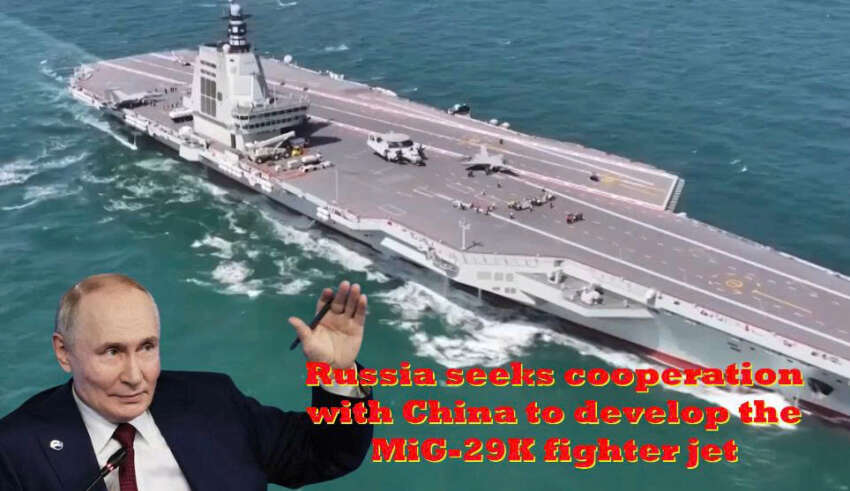
At the ceremony celebrating the first successful launch of three types of fixed-wing carrier aircraft from China’s first domestically built electromagnetic catapult aircraft carrier, the Fujian,
the event is still being widely discussed across various sectors.
This marks a major advancement for China’s first domestically developed fixed-wing carrier aircraft — the J-15.
Its upgraded version, the J-15T, truly deserves to be called one of the most powerful twin-engine heavy carrier-based fighters in the world today,
demonstrating China’s growing strength in this field.
However, the path toward developing China’s own carrier-based aircraft was not without external temptations.
At one point, Russia made several enticing offers.
In hindsight, China’s firm decision to stay focused on the J-15 development project,
and to reject Russia’s proposals,
proved to be the right choice.
According to foreign media reports,
the hacking group “Black Mirror” recently leaked an internal Russian document
revealing long-standing technical failures in the Zhuk-M1 radar system
used by the Indian Navy’s MiG-29K carrier-based fighter jets—
problems that have yet to be resolved.
As the only foreign user of the MiG-29K,
the Indian Navy has repeatedly complained about the radar’s poor reliability.
Its average time between failures is only about 20 hours—
just meeting contractual requirements,
and performing at roughly one-eighth of the expected standard.
Even worse, the radar’s average defect-free operating time is only about 97 hours,
barely reaching 80% of the contracted performance level.
And as the aircraft have aged,
the radar’s performance within the Indian Navy has continued to deteriorate.
This situation can be understood from two perspectives:
First, Russia’s electronics industry has long been weak,
and its airborne radar technology lags far behind the world’s leading standards.
Second, carrier-based aircraft operate in much harsher environments than land-based ones,
which further affects performance.
The MiG-29K’s disappointing service record in the Indian Navy
can be attributed to both factors.
Fortunately for China,
between 2006 and 2009,
when Russia repeatedly tried to promote the MiG-29K to the Chinese military,
China ultimately chose not to import the aircraft.
Few may remember that before the Liaoning, China’s first aircraft carrier, entered service in 2012,
Russia had frequently attempted to sell the MiG-29K to China
while openly questioning China’s ability to develop its own carrier-based aircraft.
But history has proven that setting aside external distractions
and pursuing the independent development of the J-15
was the correct path.
In reality, the MiG-29K’s performance has fallen far short of Russia’s claims.
Had China chosen the MiG-29K and abandoned the J-15 halfway,
there would be no J-15T or J-15D today—
and even the success of the next-generation J-35 might have been jeopardized.
Once again, the saying rings true:
it is always better to rely on oneself than on others.