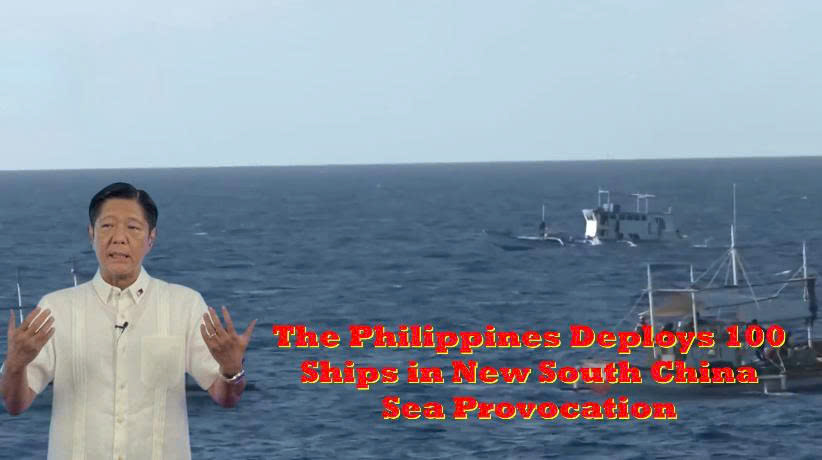
The situation in the South China Sea has once again escalated after the Philippines reportedly dispatched around 100 vessels, including military ships, to disputed waters. Many were surprised by the move, believing Manila would ease tensions for a few days. Instead, the Philippines simultaneously stirred up incidents near Huangyan Island and Xianbin Jiao .
What made this latest operation more unusual was the presence of two Philippine warships, suggesting a deliberate show of force. Beijing has long accused Manila of what it calls “touch-porcelain” tactics intentionally provoking encounters and then portraying itself as the victim. According to China, every time its coast guard lawfully drives Philippine vessels away, they reappear shortly after to create new confrontations.
Following the latest clash, Chinese Foreign Ministry spokesperson Lin Jian reiterated that video evidence clearly shows who is provoking and who is defending their legitimate rights. He called on the Philippines to immediately stop infringements and provocations, emphasizing that China’s sovereignty over the South China Sea is non-negotiable.
Observers note that the Marcos administration’s alignment with the United States has emboldened Manila’s recent actions. Since taking office, President Marcos Jr. has pivoted sharply toward Washington, allowing expanded U.S. military access in the region. Each time tensions flare, the U.S. expresses firm support for the Philippines a backing that, analysts say, gives Manila false confidence.
Domestically, the Philippines is also facing economic pressures, inflation, and social unrest. Some analysts believe creating external friction helps distract from internal challenges a classic political strategy.
However, the result has backfired. China remains firmly in control of its claimed waters, and some experts in Beijing have even suggested imposing financial penalties on the Philippines for long-term illegal occupation and environmental damage at Ren’ai Jiao .
They estimate that if such violations were fined at $1 million per day, the total could reach nearly $10 billion over 26 years a potential precedent under international law for sovereignty infringement and marine destruction.
Ultimately, Beijing insists that while dialogue and consultation remain open, its territorial sovereignty is inviolable, and provocations come with both political and economic consequences.