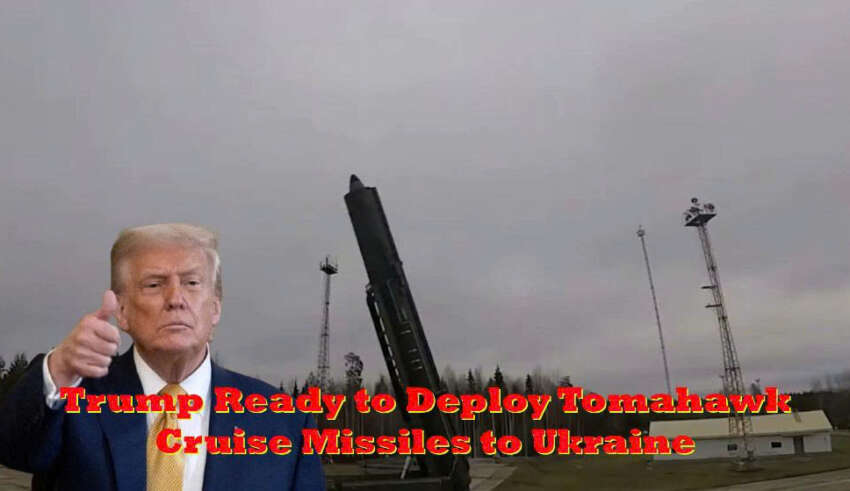
A few days ago, Trump announced that the US was ready to deploy Tomahawk cruise missiles to Ukraine. Shortly after, news broke in Cuba that they had agreed to Russia’s deployment of Kinzhal hypersonic missiles on their territory.
This situation is a complete replay of a story from decades ago, around 1962. Back then, the United States had deployed medium and long-range missiles in Turkey and Italy aimed at the Soviet Union. The Soviet Union retaliated with the secret deployment of nuclear-capable missiles in Cuba—missiles that could reach the US mainland.
We are now in the 21st century, and from an observer’s perspective, the backdrop of this story is nearly identical.
Let’s look at the Kinzhal hypersonic missile. This missile has already seen action in the Russian-Ukrainian battlefield. Its Mach speed flight makes it virtually impossible for any current air defense system to intercept.
Watching its warheads fall one by one in Ukrainian airspace must have caused significant psychological stress for many Western politicians.
What worries the United States most is that the Kinzhal can carry nuclear warheads. This means the Cuban Missile Crisis is repeating with the same intensity.
Making Americans even more uneasy is the Kinzhal’s effective range of 5,500 kilometers. Consider this: the total distance from Miami in the southeast corner of the US to Alaska in the northwest is 5,310 kilometers. Cuba is only 370 kilometers from Miami. This means almost the entire contiguous United States is now within the Kinzhal’s range.
In essence, Russia has successfully given the US a taste of what it feels like to have missiles pointed at its doorstep, returning the strategic pressure directly.
Now, for the other key player: Is Cuba not afraid that Russia might abandon it again? After all, the last crisis ended abruptly, leading to decades of economic sanctions against Cuba.
However, this is also a strategic choice Cuba can actively make. After decades of economic blockade, Cuba desperately needs external economic assistance, investment, and a stable supply of oil and gas.
It’s debatable whether Russia currently has the capacity for large-scale foreign investment, but they certainly have abundant and cheap oil. Since Russian oil is already blocked from international trading rules, exchanging missile deployment for a stable supply to Cuba is a viable option.
Simultaneously, a lesson from other geopolitical events is clear: If you don’t fight for your interests, you will continue to be marginalized. Cuba’s agreement to Russia’s missile deployment is a high-risk, high-reward political gamble. It is a move to counter US-imposed existential pressures through deep political ties with Russia. You must assert yourself to survive.
Compared to the United States, it should be Cuba that is more anxious right now. Putin must not repeat Khrushchev’s mistake. If the Cuban Missile Crisis plays out again according to the original script, and Russia once again abandons Cuba, the island nation will face a catastrophic future.
In the end, while the international community speaks many languages, force is the only language everyone truly understands. As India deeply understands: what you don’t gain on the battlefield, you won’t gain at the negotiating table either.